



POINT OF VIEW/ Keiichiro Oizumi: Indochina’s economic growth and ‘Thailand Plus One’
Low-income countries in the Association of Southeast Asian Nations have been attracting more attention in recent years.
One factor behind this is that these countries have maintained high levels of growth with lower labor costs than their neighbors. And a new supply chain of Japanese companies called “Thailand Plus One” is beginning to take shape.
Cambodia, Laos and Myanmar are attracting attention as the “last frontier of Southeast Asia.” The three countries, with the addition of Vietnam, are often referred to as “late-developing ASEAN members.”
The name refers to the fact that these countries joined ASEAN in the 1990s and onward, and that their income levels have been low in comparison with the early-developing ASEAN members of Singapore, Brunei, Malaysia, Thailand, Indonesia and the Philippines.
The average per capita GDP in the early-developing ASEAN economies was $4,446 in 2011, whereas that of the late-developing ASEAN economies was just $923.
While the early-developing ASEAN members implemented tariff liberalization in 2010, it was agreed that this could be postponed until 2015 for Cambodia, Laos, Myanmar and Vietnam in consideration of the income disparity.
However, an examination of actual GDP growth rates shows that these countries’ economies have been growing at a faster pace than the early-developing ASEAN members in recent years, and that they are expected to maintain this pace over the next five years.
The power behind these high levels of growth has been direct investment and other forms of foreign capital, including official development assistance.
In the past, the assumption has been that domestic savings rates would need to be raised for the economies of low-income countries like Cambodia, Laos and Myanmar to maintain high levels of growth.
However, with the further advancement of economic globalization in the 21st century, large amounts of foreign capital have begun to flow into low-income economies.
As long as their governments have clear development strategies, a lack of domestic capital can no longer be said to be an inhibiting factor in the economic growth of low-income countries.
For example, foreign direct investment in Cambodia was worth $846 million in 2011, or 6.5 percent of its gross domestic product.
Additionally, as wage levels in China and in the early-developing ASEAN members tend to increase, Cambodia, Laos and Myanmar are attracting growing attention as relocation destinations for labor-intensive production facilities.
A study by the Japan External Trade Organization shows that wage levels in the late-developing ASEAN members are significantly lower than those in China and the early-developing ASEAN members.
Under these conditions, development of transportation infrastructure under the Greater Mekong Sub-region development project makes all the more feasible the creation of the new business model of Thailand Plus One, which will link the cheap labor forces of Cambodia, Laos and Myanmar with Thailand’s industrial sites.
The Greater Mekong Sub-region development project was started in 1992 and advanced by the Asian Development Bank in its capacity as secretariat. As of September 2011, a total of 55 projects, worth some $14 billion, had been implemented.
Among other projects, work on the development of three cross-border economic corridors—North-South Economic Corridor, East-West Economic Corridor and Southern Economic Corridor—is almost complete.
Some of the Japanese automobile parts makers, electronic parts makers and consumer goods manufacturers operating in Thailand have begun to relocate their labor-intensive production processes to border regions, such as the Laotian province of Savannakhet and Koh Kong province and Poipet town in Cambodia.
There have yet been no signs of such activity in Myanmar, due to the lack of progress in democratization and open-door policies in that country.
However, an acceleration of this kind of development is expected in Myanmar as construction progresses on industrial sites close to its borders with Thailand along the economic corridor.
Since Cambodia and Laos have smaller populations, they are likely to face labor shortages and rising wage costs in the near future. Myanmar, however, has a growing young labor force, with a potential that is not to be missed.
According to U.N. world population prospects, as of 2010, the population size of the 15 to 29 age group is 14.1 million for Thailand and just 4.7 million for Cambodia and 2.1 million for Laos. In contrast, Myanmar has a population of 14.4 million in this age group, slightly more than even that of Thailand.
Going forward, logistics costs will be reduced further if customs tariffs in Cambodia, Laos and Myanmar are abolished and one-stop service is implemented to facilitate import and export procedures when the ASEAN economic partnership is realized in 2015.
The Thai government has revealed that it plans to invest more than 2 trillion baht (7 trillion yen) by 2020 in the development of transportation network linking Thailand and its neighbors.
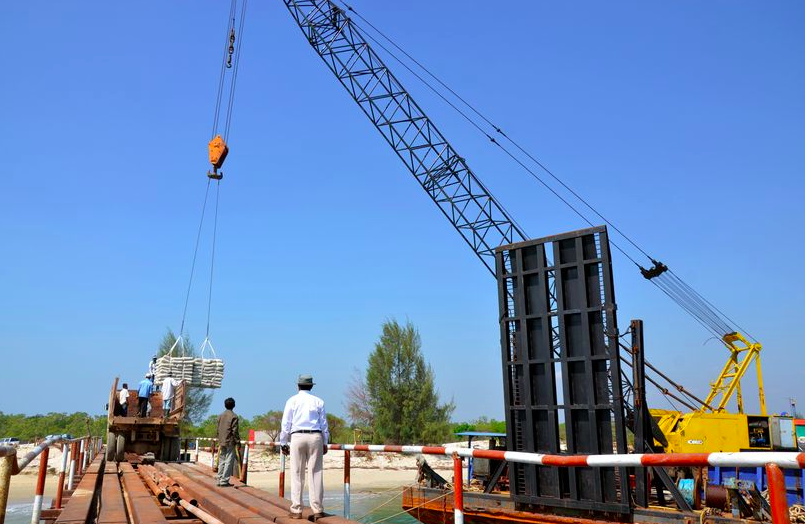
Furthermore, from a mid- to long-term perspective, the outcome of Myanmar’s Dawei Port project is thought to have a strong impact on the competitive strength of Thailand Plus One.
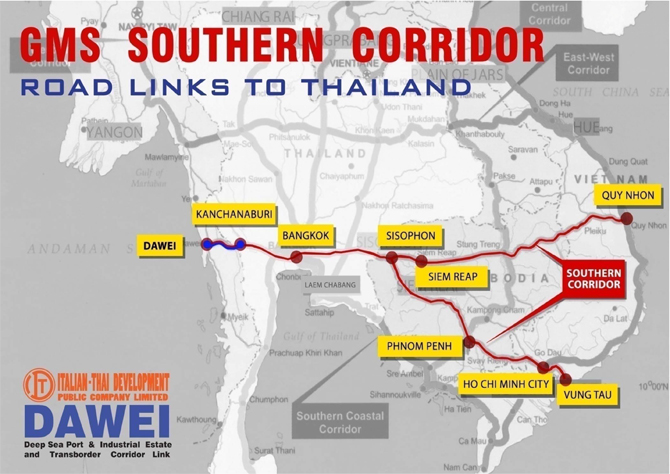
Large industrial sites and harbor facilities are planned in Dawei. If it is connected to Bangkok through trunk routes, exports will be able to go directly to India, the Middle East and Africa, instead of using the current route to bypass the Malacca Strait.
The road link between Dawei and Bangkok is seen as an extension of the Southern Economic Corridor, and may well create a new economic zone by linking Dawei to Ho Chi Minh City and Phnom Penh.
Japanese Prime Minister Shinzo Abe visited Myanmar in May and promised more than 90 billion yen in aid.
It is not yet clear to what purpose this aid will be put, but it is hoped that it will target infrastructure development that will help boost the competitive strength of the industrial sites in Thailand where many Japanese firms are established.
* * *
Keiichiro Oizumi is a senior economist at the economics department of the Japan Research Institute.
This report was published in the August 2013 edition of Asia Monthly, an English-language publication of the institute, and was edited by The Asahi Shimbun. The original report is available at (http://www.jri.co.jp/MediaLibrary/file/english/periodical/asia/2013/08/contents.pdf).
------------------
This news was published on August 21, 2013.
Source: http://ajw.asahi.com/article/views/AJ201308210030
Source of Picture "GMS Southern Corridor": http://www2.irrawaddy.org/article.php?art_id=22109
