



Decisive Win Gives Ruling Coalition Control Of Upper House
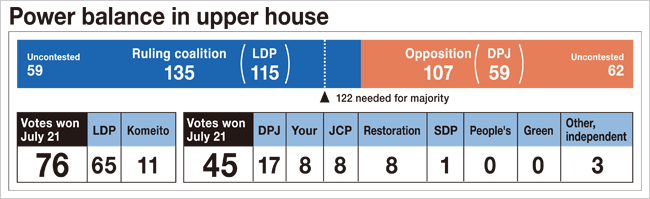
Tokyo -- Japan's ruling coalition nabbed 76 seats in the election July 21 to gain a majority in the upper house, a victory seen as a resounding affirmation of Prime Minster Shinzo Abe's economic policies.
With his ruling bloc now in control of both houses of the Diet, Abe looks secure for a long stay in office.
If the Liberal Democratic Party (LDP)-led coalition can successfully handle the sales tax hike and other key economic and diplomatic challenges, it may not have to fight another general election for three years, giving Abe the stability to focus on policies.
The LDP's triumph in the upper house election makes Abe the first prime minister to lead the party to successive overwhelming wins in both houses since the 1996 electoral reforms.
The LDP secured 65 seats, a record under the current election system, while coalition partner New Komeito won 11. Of the 242 upper house seats, 121 were up for grabs, with the ruling coalition already holding 59 seats that were not contested. The results give the duo control of both chambers of the Diet, paving the way for smoother, less-confrontational Diet management.
The main opposition Democratic Party of Japan (DPJ), which had held 44 of the contested seats, suffered a crushing defeat, securing just 17, a record low for the party.
This election marked the debut of Internet campaigning in Japan, but online efforts apparently failed to bring out voters in large numbers. The voter turnout was 52.61%, down 5.31 percentage points from the 2010 election, and the third lowest since the end of World War II in 1945, after 44.52% in 1995 and 50.72% of 1992.
Financial markets reacted calmly to the election results, since they were in line with expectations. The Nikkei Stock Average rose mildly on the first two days of the week, up 0.47% and 0.82% respectively, to close at 14,778.51 on July 23. The yen strengthened against the dollar. At 5 p.m. in Tokyo on July 22, it gained 0.34 from July 19's level to 100.00-01 to the dollar and another 0.54 on July 23. With the election over, there was little immediate pretext to sell the yen further, traders said. Some market participants took profit on the dollar, though expectations for further weakening of the yen remain.
The LDP will become the top party in the upper chamber with a total of 115 seats, retaking this position for the first time in six years. The ruling coalition's 76 wins far outpace the 63 needed to claim a majority in the chamber. Including the seats not contested in the latest election, the LDP and New Komeito will hold a combined 135 seats, topping the 129 needed for a stable majority that gives the coalition control over all committees in the chamber. The winners will serve six-year terms through 2019.
The LDP showed its strength in single-seat constituencies by winning 29 out of 31. The results contrasted with the DPJ's, which lost in all 19 single-seat constituencies in which it fielded candidates.
The LDP lost to incumbents in Iwate and Okinawa prefectures. In Iwate, the LDP failed to gain the support of farmers opposed to joining the Trans-Pacific Partnership free trade talks. In Okinawa, an incumbent who opposes the government's policy on a controversial U.S. military base prevailed.
The LDP also performed well in multiple-seat races, winning two seats each in Chiba and Tokyo. On the other hand, the DPJ ended up competing with other opposition parties, losing seats in Miyagi, Kyoto and Hyogo prefectures.
In proportional representation, the LDP grabbed 18 seats, becoming the top party in this field for the first time in 12 years.
Meanwhile, New Komeito nabbed four seats in prefectural constituencies and seven in proportional representation.
The DPJ's tally in the election was its weakest showing since its inception in 1998, falling below the previous low of 26 marked in 2001. The Japan Restoration Party won a combined eight seats, falling short of its targeted 10. The Japanese Communist Party won eight seats, securing seats through electoral districts for the first time in 12 years.
The DPJ's Goshi Hosono told the press July 23 that he would resign as secretary-general to take responsibility for the party's loss.
Emboldened by the increased mandate, Abe intends to work faster on a second round of growth-promoting measures. Speaking to the press at LDP headquarters on the night of July 21, he said: "I want to move forward speedily on an economic growth strategy and other policies."
The LDP's tax committee, taking its cue from the prime minister, plans to move up the discussion on incentives for corporate investment. Indeed, the Prime Minister's Office is likely to play an even bigger role in policymaking than it has so far in Abe's second run. Some in the LDP worry that it won't tolerate dissent from the party on budget matters.
Abe plans to refresh his cabinet in September, ahead of the short legislative session likely to start the following month. The reshuffle will coincide with the appointment of some senior LDP officials, among whom Secretary-General Shigeru Ishiba, essentially the party's second-in-command, is expected to stay on.
The prime minister has said he wants to dedicate the coming Diet session to carrying out his growth strategy. Other priorities include revising the Self-Defense Forces' legal writ and creating a Japanese version of the U.S. National Security Council. The ruling bloc now has the upper house majority it needs to usher these and other bills into law. No longer will the opposition be able to hold legislation hostage.
Among the challenges Abe's government will face are deciding whether to go ahead with a consumption tax hike, a choice likely to be made in October; negotiating the Trans-Pacific Partnership (TPP), a U.S.-led free trade pact; and handling the issue of restarting nuclear reactors. The LDP's sweeping victory should help Abe with these and other matters.
Some Abe aides are already looking three years ahead to the possibility of simultaneous elections in both Diet houses. Even such a lofty goal would not be out of reach should Abe keep his momentum. The main opposition party, the DPJ, was trounced in the July 21 poll, and the prime minister has no widely popular contenders for leadership within his own party.
Abe's good fortune is not guaranteed to last. For all his globe-trotting diplomacy, he has yet to find a way to mend fences with China and South Korea. Should he give expression to the conservative streak he has kept hidden, he may alienate parts of the LDP, not to mention the public and other countries. Abenomics, too, if mishandled, could quickly change from a cause for hope to a source of disappointment.
China and South Korea expressed concern over the prospect of a stable government under Abe, known to be staunch on history and territorial issues about which the two neighbors are nervous. China's Xinhua news agency said late on July 21 that if Abe executes right-leaning policies on the back of his resounding victory, Japan will become a destabilizing factor for the international community. A senior South Korean Foreign Ministry official said Japan's actions need to be monitored carefully.
Some insiders in both governments, however, also expressed hope that a stable government could open way for long-term efforts to improve strained relations.
-------------------
This news was published on July 24, 2013.
Source: http://e.nikkei.com/e/fr/tnks/Nni20130724D23HH856.htm
